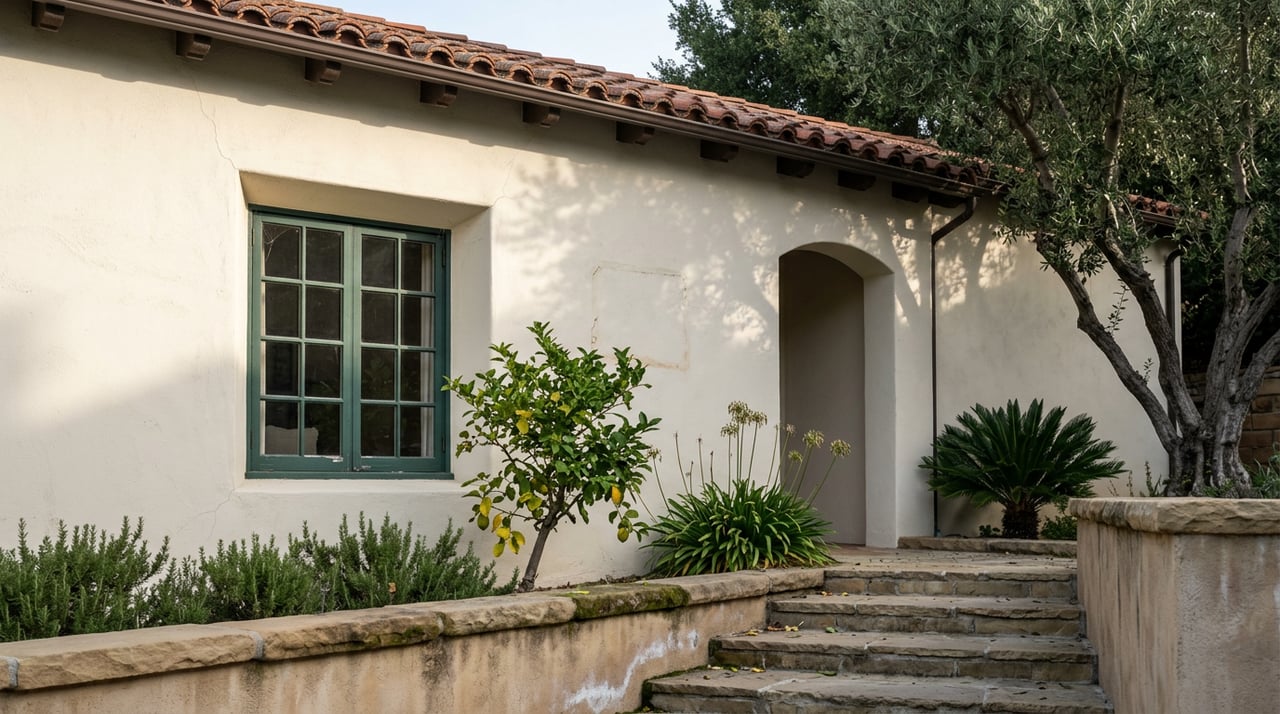
On July 15, 2026, the Santa Barbara Historic Landmarks Commission held a public hearing on a single-family house at 1242 Dover Lane and voted to designate it a City Structure of Merit. Nothing about the house's façade changed that afternoon. What changed was its renovation rules and its eligibility to seek a different tax treatment through a financial mechanism most buyers never think to ask about until the escrow paperwork is already moving.
That mechanism is the Mills Act, and it is the reason two Riviera homes with identical asking prices can carry meaningfully different real costs of ownership. The difference does not show up on a listing sheet. It shows up on a property tax bill, and only if someone thought to check for it.
The assumption that doesn't hold
Most buyers price an older Santa Barbara home the way they'd price any home: purchase price, estimated property tax based on assessed value, done. That math works fine for a 1985 tract house. It breaks down for a designated historic property, because the City of Santa Barbara says it has run the Mills Act program since 2009, with participating owners typically seeing a 40 to 60 percent reduction in property taxes over the ten-year contract period; the city describes the contract as perpetual, and its Mills Act contract terms bind successor owners, not just the person who negotiated it.
If you're comparing two similar Riviera or Upper East homes, one with an active Mills Act contract and one without, the sale price tells you almost nothing about which one actually costs less to hold. You have to ask the second question.
What the Mills Act actually is
The Mills Act is a California program, and Santa Barbara has participated since 2009. Under the city's version, an owner of a designated Structure of Merit or City Landmark signs a contract agreeing to actively maintain and restore the property. In exchange, the assessed value used to calculate property tax is recalculated, and participating owners typically see a 40 to 60 percent reduction in property taxes over the ten-year contract period.
The contract isn't tied to the person who signs it. It's tied to the property. Under the state's enabling statute, a Mills Act contract runs with the land, so when the home sells, the buyer inherits both the tax benefit and the maintenance obligations without having to reapply. That's the part that turns this from a curiosity into a pricing variable: the seller isn't just handing over a house, they're handing over an existing tax arrangement that took years to establish.
Here's what that looks like in practice, using illustrative numbers to show the shape of the difference rather than any specific address:
| Home without a Mills Act contract | Home with an active Mills Act contract | |
|---|---|---|
| Illustrative annual property tax on a comparable assessed value | $9,000 | $3,600 to $5,400 (a 40 to 60 percent reduction) |
| Who gets the benefit at closing | Whoever eventually completes designation and application, a process that can run well over a year | The buyer, automatically, the day escrow closes |
| Ongoing obligation | Standard maintenance | A ten-year preservation plan reviewed periodically by the city's Architectural Historian |
The right-hand column isn't free money. It comes with a maintenance commitment and periodic inspection. But for a buyer who already wants to preserve an older home's character, that obligation is often just a description of what they were planning to do anyway.
Why you can't just apply your way into it
If a home you're considering is Mills Act eligible but doesn't have a contract yet, the temptation is to assume you can sort that out after closing. The timeline says otherwise.
The city only accepts Mills Act applications during a fixed window, January 1 through June 30 each year, and even within that window the program has a cap. The city may accept applications only until the program reaches its annual revenue loss limit of $260,000, so a strong applicant pool in a given year can close out the cycle before June arrives. Miss the window or the cap, and the application rolls to the following year.
Because today is mid-August 2026, that window closed more than six weeks ago. Anyone who buys a historic-eligible Riviera or Lower Riviera home this fall and wants to pursue a Mills Act contract is looking at a 2027 application at the earliest, and that's before the designation and review process even starts.
The designation process itself has its own sequence. City of Santa Barbara guidance on Structures of Merit says a nomination, whether from the owner, a member of the public, or the Historic Landmarks Commission, goes to the city's Architectural Historian, who prepares a Significance Report. If that report recommends designation, Santa Barbara's municipal code requires the item to be scheduled for a public hearing within 90 calendar days. The Historic Landmarks Commission itself meets biweekly. City of Santa Barbara historic-resources designation guidance says a Structure of Merit designation is made by the Commission directly, while a City Landmark designation requires an additional step: City Council approval after an HLC recommendation. Only after designation is complete can the owner file for the Mills Act.
Laid out end to end, the path looks like this:
- Nomination submitted to the Architectural Historian
- Significance Report prepared and, if favorable, a public hearing scheduled within 90 days
- Historic Landmarks Commission hearing and designation as a Structure of Merit, or a recommendation forwarded to City Council for Landmark status
- Mills Act application filed, but only between January 1 and June 30
- Application reviewed against the $260,000 annual cap, with unaccepted applications rolling to the next year
That's not a same-year project. It's a multi-cycle one, which is exactly why an existing Mills Act contract on a home you're buying is worth more than the promise that you could get one yourself eventually.
What the designation restricts, and what it doesn't
A common misread is that historic designation freezes a house. It doesn't, and the distinction matters for anyone planning a kitchen remodel or a primary suite update. The Historic Landmarks Commission reviews exterior alterations only; interior changes are not part of its jurisdiction. A Structure of Merit designation puts all exterior alterations under HLC review, while a City Landmark designation, the city's highest distinction, goes further: a Landmark cannot be demolished under any circumstance short of an unforeseeable natural disaster.
The City of Santa Barbara's historic-resources guidance says that a rule applies whether or not a house is ever formally designated: any structure 50 years or older that hasn't already been evaluated must go through a historic resource assessment before the city will approve an addition, alteration, or demolition. For neighborhoods like the Lower Riviera, where the city's ongoing Bungalow Haven survey is actively cataloguing contributing structures, that review can apply to homes that look entirely ordinary from the street. It's worth checking before you assume a 1962 ranch house is a simple remodel candidate.
For context on how deep this runs in Santa Barbara specifically: the City of Santa Barbara's Historic Landmarks Commission says El Pueblo Viejo, the city's oldest protected district, traces to a 1959 resolution and a March 1960 ordinance that formally established the district and prohibited the demolition of any adobe structure within its downtown and waterfront boundaries. The Lower Riviera Special Design District layers additional review on top of that for a neighborhood the city is still actively surveying. Buyers looking at homes in either area should expect the historic review question to come up regardless of whether the specific house they're considering carries a formal designation yet.
The version of this that catches estates and heirs off guard
This detail matters most, and gets missed most often, in probate and estate transactions. A family selling a longtime Riviera home may not know whether a Mills Act contract exists on the property, especially if the original owner set it up years ago and the paperwork lived in a filing cabinet rather than institutional memory. An executor pricing the home for sale, or a buyer evaluating an estate listing, should ask the same question either way: is there an active Mills Act contract recorded against this parcel, and if so, what's left of the ten-year term?
Santa Barbara structures its Mills Act contracts as a perpetual 10-year term with the city, and the designation resolution itself is recorded with the Santa Barbara County Recorder. None of that expires quietly. It sits in the record until someone checks for it, which means the tax advantage is either a documented asset changing hands at closing or an invisible cost sitting unclaimed on a property nobody thought to look at closely.
A few questions worth asking before you write an offer
Does a Mills Act contract automatically transfer when I buy a historic home in Santa Barbara? Yes. The contract runs with the property under state law, so a buyer inherits both the tax benefit and the preservation obligations at closing, with no need to reapply.
Can I apply for a Mills Act contract on a home I'm buying right now? Only during the city's window, January 1 through June 30. Since that window closed for 2026, a new application would need to wait for the 2027 cycle, and that's assuming the home has already completed historic designation.
Does a Structure of Merit designation stop me from remodeling the inside of the house? No. The Historic Landmarks Commission reviews exterior alterations only. Interior renovations fall outside its jurisdiction.
If you're weighing a historic property in the Riviera, Lower Riviera, or anywhere else in Santa Barbara where designation and Mills Act eligibility might be in play, it's worth having someone check the actual county record before you price the house on assumptions. Hitchcock + Associates works through exactly this kind of detail for buyers, sellers, and estates across Santa Barbara's historic inventory. Request a complimentary home valuation and we'll walk you through what's actually recorded against the property, not just what's listed.
This article is general information, not legal, tax or financial advice. Consult a qualified professional about your situation.